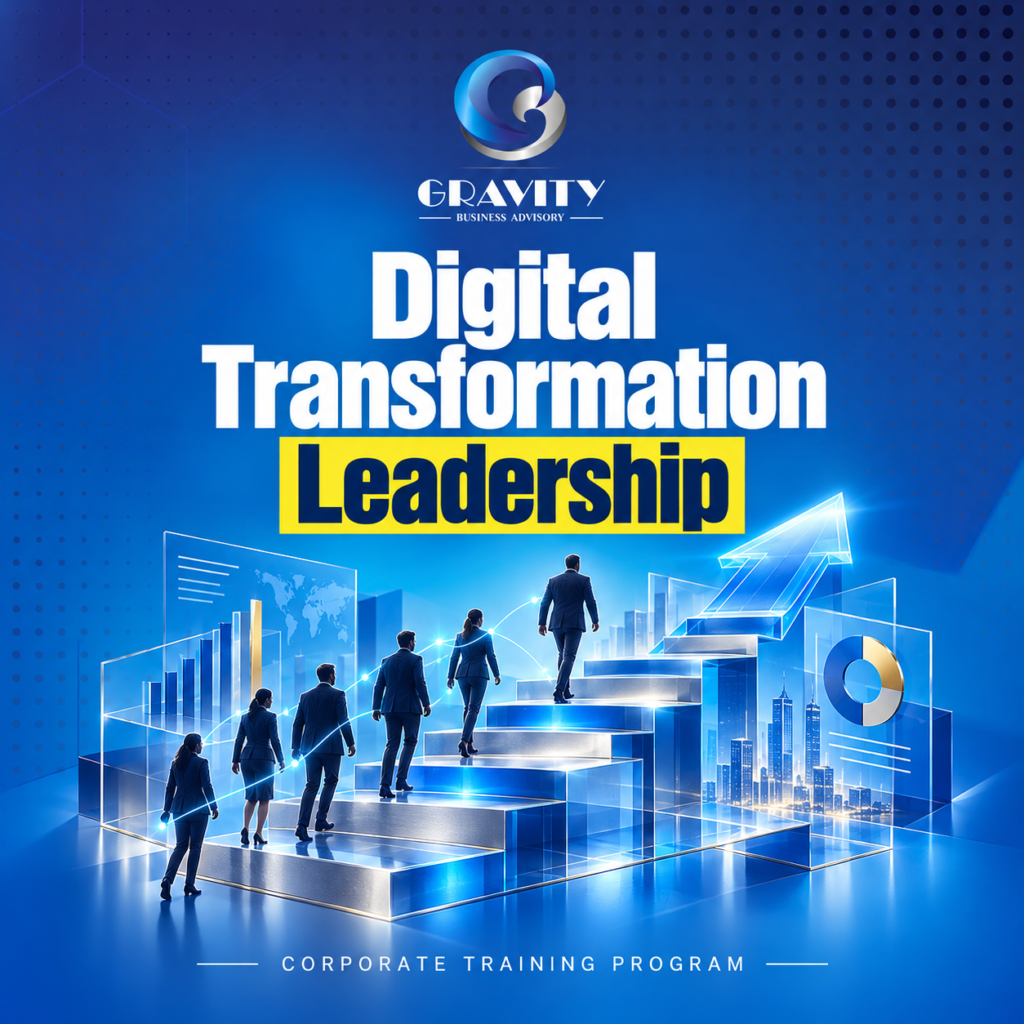
Digital Transformation Leadership

الحضور : عام
التقييم العام :
Digital Transformation Leadership

📖نبذة عن البرنامج

A practical executive journey from strategic diagnosis to sustained implementation.

Transformation succeeds when strategic choices, people, operating systems and execution reinforce one another. Participants build a sponsor-ready blueprint around a real organizational challenge. Align people and strategy to deliver measurable and lasting change.

The program connects strategy, people and execution through 10 modules and one integrated challenge: clarify trade-offs and intended value; connect vision, capabilities and behavior; assign decisions, KPIs and benefit owners; review evidence and adapt priorities.

Duration: 2 days, with 12 scheduled hours comprising 11 facilitated learning hours and 1 hour of breaks. Dates: 25 - 26 November 2026. Time: 10:00 AM – 4:00 PM. Venue: Hotel. Delivery language: English. Trainer: Dr. Nizar Baidoun. Fee: KWD 200.

Group offer: Register two candidates and the third candidate attends free of charge.
📝وصف البرنامج

This program is suitable for:

  • Executives: Set direction and sponsor change.
  • Department heads: Translate strategy into team commitments.
  • Transformation leaders: Coordinate governance and benefits.
  • HR and OD leaders: Align culture, behavior and capability.
  • Digital leaders: Connect technology to value and adoption.

Level: Executive level, for senior and middle managers.

Prerequisites: Management or change responsibility. Bring an anonymized challenge and a baseline. A laptop is useful; no programming is required.

☷محاور البرنامج

Day 1: Diagnose and Align

25 November 2026.

Diagnose and Make Strategic Choices — M0-M2

Break: 11:30–11:45 AM.

M0: Strategic Transformation and Change — 0.5 hour

  • Key topics: Transformation versus incremental improvement; strategic and operating model shifts. Performance gaps, readiness, sponsor accountability and the case for change.
  • Practical objectives: Diagnose one strategic gap using evidence rather than symptoms. Define a transformation mandate with a sponsor, scope and intended value.
  • Tools: Mandate canvas; current-to-future state gap analysis.
  • Application: Frame one strategic gap and test the mandate with a peer.
  • Expected output: Transformation mandate.

M1: Leading Through Uncertainty and Disruption — 1 hour

  • Key topics: Signals, uncertainty and interdependent risks; contrasting scenarios. No-regret actions, early-warning triggers and leadership communication.
  • Practical objectives: Construct two contrasting scenarios around one critical uncertainty. Choose an immediate action and a trigger for changing course.
  • Tools: PESTLE; scenario matrix; assumptions and trigger log.
  • Application: Respond to a simulated market shock and brief the sponsor.
  • Expected output: Scenario response map.

M2: Strategic Thinking and Decision Making — 1 hour

  • Key topics: Systems thinking, root causes, strategic options and resource trade-offs. Decision bias, disconfirming evidence and conditions for reversing a choice.
  • Practical objectives: Compare three credible options against explicit weighted criteria. Defend a choice and identify evidence that would reverse it.
  • Tools: Causal map; weighted decision matrix; pre-mortem.
  • Application: Compare three responses and stress-test the critical assumption.
  • Expected output: Strategic decision brief.

Align the Vision and Engage Stakeholders — M3-M4

25 November 2026. Break: 2:15–2:30 PM.

M3: Transformation Vision and Strategic Alignment — 1.5 hours

  • Key topics: A credible vision, consequences of inaction and measurable strategic outcomes. Align structure, processes, skills, technology and incentives with priorities.
  • Practical objectives: Write a concise vision with three measurable transformation outcomes. Identify two organizational misalignments and assign actions to resolve them.
  • Tools: Vision narrative; strategy-to-outcomes map; alignment checklist.
  • Application: Map the future state and rehearse the leadership message.
  • Expected output: Vision and alignment map.

M4: Stakeholder Engagement and Influence — 1.5 hours

  • Key topics: Power, informal influence, stakeholder interests and perceived losses. Sponsor coalitions, negotiation, listening and evidence of commitment.
  • Practical objectives: Prioritize five stakeholders by influence, impact and current commitment. Negotiate a specific commitment with a skeptical stakeholder.
  • Tools: Power-impact map; commitment matrix; influence planner.
  • Application: Negotiate a commitment with a skeptical stakeholder.
  • Expected output: Stakeholder commitment plan.

Day 2: Mobilize, Execute and Sustain

26 November 2026.

Mobilize People and Lead Change — M5-M7

Break: 12:00–12:15 PM.

M5: Culture and Behavioral Transformation — 1 hour

  • Key topics: Values versus behavior; culture reinforced by systems and leadership routines. Psychological safety, accountability, motivation and reinforcement.
  • Practical objectives: Specify two observable behaviors required by the future state. Design one reinforcement mechanism and one measure of behavior change.
  • Tools: Culture evidence scan; behavior-driver analysis; reinforcement plan.
  • Application: Redesign a routine that rewards the old way of working.
  • Expected output: Behavior change plan.

M6: Innovation and Digital Transformation — 1 hour

  • Key topics: User problems, digital and AI opportunities, data readiness and capabilities. Experiment hypotheses, responsible use and scale/pivot/stop criteria.
  • Practical objectives: Select a digital opportunity that supports a strategic outcome. Design a bounded experiment with a success threshold and stop condition.
  • Tools: Value-feasibility matrix; experiment charter; oversight checklist.
  • Application: Define a digital pilot and the evidence needed to scale.
  • Expected output: Digital experiment charter.

M7: Change Leadership and Resistance Management — 1 hour

  • Key topics: Resistance versus valid risk, workload or capability barriers. Readiness, change saturation, champions, coaching and adoption support.
  • Practical objectives: Diagnose the cause of resistance for two affected groups. Select interventions and adoption measures tailored to those causes.
  • Tools: Impact assessment; force-field analysis; adoption tracker.
  • Application: Diagnose a team’s refusal of the pilot and plan support.
  • Expected output: Adoption and resistance plan.

Govern Execution and Sustain Agility — M8-M9

26 November 2026. Break: 2:15–2:30 PM.

M8: Execution Governance and Transformation KPIs — 1 hour

  • Key topics: Workstreams, dependencies, decision rights, escalation and benefit ownership. Leading and lagging KPIs, baselines, targets and benefits realization.
  • Practical objectives: Assign decision rights and escalation thresholds for the initiative. Define four KPIs with baselines, targets, owners and review frequency.
  • Tools: Responsibility matrix; dependency roadmap; risk register; benefits scorecard.
  • Application: Challenge an initiative that meets milestones but lacks adoption.
  • Expected output: Governance and KPI scorecard.

M9: Sustaining Agility and Executive Capstone — 1.5 hours

  • Key topics: Embed ownership, transfer capability and sustain feedback routines. Reprioritize the portfolio through 30/60/90-day milestones and decision gates.
  • Practical objectives: Set a 90-day roadmap with milestone owners and evidence-based decision gates. Defend an integrated transformation blueprint and improve it using challenge feedback.
  • Tools: 30/60/90-day roadmap; retrospective; scale/pivot/stop gate.
  • Application: Integrate M0-M8 into a sponsor pitch and 90-day action plan.
  • Expected output: 90-day transformation blueprint.

Training Methodology

  • Concepts → application → peer challenge → revision.
  • 11 facilitated learning hours within 12 scheduled hours; activities, exercises and assessment are included in module time.

Assessment: From Learning to Workplace Application

  • PRE — Diagnostic: Leadership role, change experience and one initiative with a baseline.
  • MID — Knowledge checks: Scenario questions, reasoned answers and corrective feedback.
  • LAB — Applied outputs: Ten outputs reviewed for evidence, consistency and peer feedback.
  • END — Executive capstone: Integrated blueprint, sponsor ask and a personal 30-day commitment.
  • Strategic logic — 25%: Mandate, choices, vision and measurable outcomes.
  • People and adoption — 25%: Stakeholders, behaviors and resistance responses.
  • Execution and value — 30%: Owners, gates and baseline-to-target KPIs.
  • Agility and defense — 20%: 90-day roadmap, review triggers and challenge response.

🏅فوائد البرنامج

By the end of the program, participants will be able to:

  • Strategic diagnosis: Frame a mandate with evidence and value.
  • Adaptive judgment: Use scenarios and explicit assumptions.
  • Vision and alignment: Connect outcomes and capabilities.
  • Influence: Secure stakeholder commitments.
  • Culture leadership: Align behavior, routines and incentives.
  • Innovation and adoption: Test digital value and manage resistance.
  • Execution accountability: Assign governance and transformation KPIs.
  • Sustained agility: Defend a 90-day blueprint and review gates.

Participant Materials

  • Scenario, decision and stakeholder tools.
  • Behavior and adoption fields.
  • Governance scorecard, assessment rubric and a 90-day blueprint.
السعر
200,000 د.ك
👨‍🏫
InstructorDr. Nizar Baidoun
⏱
Duration2 days (11 facilitated learning hours within 12 scheduled hours, including 1 hour of breaks)
🎯
Skill LevelExecutive level
📅
Date25 - 26 November 2026
🕒
Time10:00 AM – 4:00 PM
📍
LocationHotel